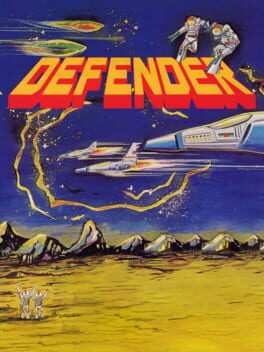
Defender
Defender — frequently asked questions
- What platforms is Defender on?
- Defender was released on Arcade, Web browser, Mac, Atari 2600, Atari 5200, ColecoVision, Intellivision, Atari 8-bit, Adventure Vision, Commodore VIC-20, Texas Instruments TI-99, Apple II, Commodore C64/128/MAX, IBM PC, ZX Spectrum, BBC Microcomputer System, Game Boy, SAM Coupé.
- When did Defender release?
- Defender was first released on March 1, 1981.
About Defender
Defender is an arcade video game developed released by Williams Electronics in 1980. A shooting game featuring two-dimensional (2D) graphics, the game is set on a fictional planet where the player must defeat waves of invading aliens while protecting astronauts. Development was led by Eugene Jarvis, a pinball programmer at Williams; Defender was Jarvis's first video game project, and drew inspiration from Space Invaders and Asteroids. Williams planned to display the game at the Amusement & Music Operators Association (AMOA) trade show, though development delays resulted in the team working on the game up until the show started. Defender was commercially successful, selling over 55,000 units to become the company's best selling arcade game. Praise among critics focused on the game's audio-visuals and gameplay. It is frequently listed as one of Jarvis's best contributions to the video game industry, as well as one of the most difficult video games. Defender was ported to numerous platforms, inspired the development of other games, and was followed by sequels and many imitations.
Summary via IGDB.
Game details
- Platforms
- Arcade, Web browser, Mac, Atari 2600, Atari 5200, ColecoVision, Intellivision, Atari 8-bit, Adventure Vision, Commodore VIC-20, Texas Instruments TI-99, Apple II, Commodore C64/128/MAX, IBM PC, ZX Spectrum, BBC Microcomputer System, Game Boy, SAM Coupé
- Publisher
- Williams Electronics
- Game modes
- Single player, Multiplayer
- Themes
- Action, Science fiction
Details via IGDB.
Reception
Every version compared
Prices, contemporary reception and the studio credited for each release
| Platform | Year | Loose | Complete | Sealed | Period reviews | Built by | Fake risk |
|---|---|---|---|---|---|---|---|
| Atari 2600Details ↓ | 1982 | $8 | $18 | $35 | 2 reviews | Atari (designed by Bob Polaro) | Low |
| Atari 5200Details ↓ | 1982 | $8 | $20 | $29 | Graphics ★★★½ · Play-Action ★★★★ | — | Low (look-alike) |
| ColecoVisionDetails ↓ | 1983 | $16 | $30 | $43 | Graphics ★★★ · Play-Action ★★★½ | Atarisoft (publisher) | Low (look-alike) |
| IntellivisionDetails ↓ | 1983 | $22 | $52 | — | — | Peter Farson | Low (look-alike) |
The cheapest way to own it loose is the Atari 2600 version ($8).
Release timeline
- ArcadeMar 1981
- Atari 5200Dec 1982
- Atari 26001982
- Atari 8-bit1982
- Commodore VIC-20Oct 1983
- Texas Instruments TI-99Nov 1983
- IntellivisionDec 1983
- ColecoVisionDec 1983
- Apple II1983
- DOS1983
- Commodore C64/128/MAX1983
- Mac1994
- Handheld Electronic LCD1997
- Game Boy ColorMar 31, 1999
- Web browserJul 2000
- PC (Microsoft Windows)Nov 15, 2006
- Xbox 360Nov 15, 2006
First release on each platform, from IGDB’s records of this game’s ports and editions. Remakes are separate games with their own pages, so they are not listed here.
We haven’t priced or authenticated the versions without a section on this page yet.
Prices are per version and are not interchangeable, and neither are the reviews: conversions in this era were often built by a different studio than the original, so a score earned on one machine says nothing about how another plays.
Collector value & authenticity
Atari 2600 · PriceCharting sold data · Verified 2026-10-06
Other releases and variants
| Release | Loose | Complete | Sealed |
|---|---|---|---|
| Tele-Games | $4 | $20 | — |
How often it sells
- Loose: about once a day
- Complete: about once a week
- Sealed: about once a week
Sales frequency from PriceCharting's completed-sale records, as of 2026-10-19.
Price over time
- Loose
- Complete
A loose copy sold for about $0.38 in Oct 2008, $3.20 five years ago, and $7.60 as of Oct 2026.
Show as table
| Month | Loose | Complete |
|---|---|---|
| Jan 2009 | $0.01 | — |
| Jan 2010 | $0.01 | — |
| Jan 2011 | $0.75 | — |
| Jan 2012 | $0.87 | — |
| Jan 2013 | $0.87 | — |
| Jan 2014 | $2.41 | $6.97 |
| Jan 2015 | $2.89 | $8.49 |
| Jan 2016 | $2.99 | $15.99 |
| Jan 2017 | $4.19 | $8.97 |
| Jan 2018 | $4.95 | $8.97 |
| Jan 2019 | $4.00 | $8.55 |
| Jan 2020 | $5.12 | $9.49 |
| Jan 2021 | $4.99 | $12.63 |
| Jan 2022 | $4.55 | $13.28 |
| Jan 2023 | $6.43 | $14.48 |
| Jan 2024 | $3.41 | $15.91 |
| Jan 2025 | $2.50 | $18.16 |
| Jan 2026 | $4.96 | $16.37 |
| Oct 2026 | $7.60 | $18.41 |
Monthly price estimates from PriceCharting's completed-sale records, sampled quarterly, through Oct 2026.
Release record
| Territory | Label | Catalog # | Rarity |
|---|---|---|---|
| North America Atari | Picture | CX2609 | Common |
| North America Sears | Picture - Red Text | 49-75186 | Common+ |
| Europe Atari | Picture - Blue label | CX2609 | Rare+ |
| Europe Unknown | Pet Boat | — | — |
| Asia Atari | — | — | — |
Also released in South America by Digitel, Polygram, Polyvox.
Source: Catalog numbers, label types, rarity, controllers and player counts: AtariAge 2600 software database
- Region
- NA+EU
- Released
- 1982
- Controller
- Atari Joystick
- Players
- 1 - 2
- Authenticity
- Low
The Atari 2600 version
Atari's 2600 conversion of the Williams arcade classic, a multi-million seller and one of the cheapest carts around.
Williams' 1981 arcade Defender, led by Eugene Jarvis, has you defeat waves of aliens while protecting astronauts on a horizontally scrolling planet. It was one of the most important games of the golden age of arcades and established the horizontal scrolling shooter.
Atari released the 2600 version in 1982, with Bob Polaro credited as designer. It was one of the best-selling games for the system, selling over 3 million cartridges, which is why copies are so easy to find.
How it was made
Designed by Bob Polaro and released by Atari in June 1982, with a PAL release the same year. Sears sold it too.
What the press said at the time
| Computer Entertainer Vol. 1 No. 4 | July 1982 | Graphics ★★★ · Play-Action ★★★★ |
| Arcade Express Vol. 1 No. 7 | 1983 | 9/10 |
“Sound the trumpets! Beat the drums! It's time for VCS owners to dance in the streets, because Atari has just published its best videogame cartridge since Missile Command!”
“Some quarter-snatchers have reached the home arcades of America in cruelly distorted form, but this VCS edition is a loving tribute to the original.”
“This is a good game for those who love shoot-em-ups … Better-than-average Atari graphics and challenging play options should make this one a favorite.”
“It isn't quite the same as the coin-op original, but it's a fine home screen-scrolling shootout nevertheless.”
Computer Entertainer rated graphics first and play action second, from four symbols (excellent) to one (poor) — stars in most years, diamonds in 1986–87 — comparing each game only with other games for the same system.
Cartridge & preservation record
Program size 4 KB, measured from the preserved dump.
Catalogue number as recorded for the physical release.
How the Atari 2600 version differs
Because the 2600 joystick has only one button, the fire button fires the laser, launches a smart bomb or triggers hyperspace depending on how high the ship is on the screen.
The ship vanishes from the screen whenever it fires its laser, and cannot be hit while it is gone. Electronic Games called this disturbing at first but a subtle nuance of play once players got used to it.
The Space Gamer thought the 2600 cartridge belonged in every library despite the console's graphical limits, but said arcade purists would miss the original controls.
Also on other platforms
Arcade · Atari 5200 · Atari 8-bit · Adventure Vision · VIC-20 · ColecoVision · TI-99/4A · Intellivision · Apple II · Commodore 64 · IBM PC · ZX Spectrum · BBC Micro · Game Boy · SAM Coupé
| Atari 2600 | Atari (designed by Bob Polaro) |
| Atari 8-bit | Steve Baker |
| Intellivision | Peter Farson |
| VIC-20 | Greg Omi |
| Commodore 64 | Joseph Simko |
- Atari 5200. The 5200 port, released in November 1982, has updated visuals; Creative Computing compared it favorably to the arcade original and praised its gameplay variations.
- Atari 8-bit. Softline readers ranked the Atari 8-bit version fifth among Atari programs in 1983, but the magazine said its appeal did not justify the high cost of a ROM cartridge.
- IBM PC. Computer Games found Atarisoft's IBM PC version fast but soon boring, and said its keyboard controls were unsuitable for the quick maneuvers the game requires.
Worth knowing
- The vanishing ship. Electronic Games defended the flicker in November 1982: "Alas, every time the Defender fires its laser, the ship disappears! This is somewhat disturbing at first, but it becomes a subtle nuance of play once the arcader gets used to it. When the ship is firing — and hence, off screen — it can't be hit".
- The programmer's lucky 25. Atari Age published the full method for the hidden "BP" initials on the 25th wave, adding: "The height you need to hit is actually the 25th line of vertical resolution from the bottom — another example of the programmer using his lucky number 25."
- First comic pack-in. Atari Age announced: "The first cartridge to include a bonus comic book is Defender. This full-color 48-page adventure" was followed by comics in Berzerk and Star Raiders.
Before you buy
Low risk; this is a very common cart. Two labels are priced: the standard Atari cart and a Sears Tele-Games cart. Both are cheap loose, and boxed copies cost about the same. Check which label the photos show if you are collecting Sears variants; otherwise buy whichever is cheapest.
Collector value & authenticity
Atari 5200 · PriceCharting sold data · Verified 2026-10-19
How often it sells
- Loose: about 2 times a month
- Complete: about once a month
- Sealed: about once a month
Sales frequency from PriceCharting's completed-sale records, as of 2026-10-19.
Price over time
- Loose
- Complete
A loose copy sold for about $1.87 in Jan 2010, $7.21 five years ago, and $7.50 as of Oct 2026.
Show as table
| Month | Loose | Complete |
|---|---|---|
| Jan 2010 | $1.87 | — |
| Jan 2011 | $1.74 | — |
| Jan 2012 | $0.99 | — |
| Jan 2013 | $0.87 | — |
| Jan 2014 | $2.81 | $3.25 |
| Jan 2015 | $4.99 | $12.59 |
| Jan 2016 | $3.38 | $10.94 |
| Jan 2017 | $6.25 | $0.99 |
| Jan 2018 | $6.25 | $10.00 |
| Jan 2019 | $5.90 | $9.99 |
| Jan 2020 | $4.06 | $11.14 |
| Jan 2021 | $6.62 | $25 |
| Jan 2022 | $5.61 | $19.41 |
| Jan 2023 | $7.05 | $12.80 |
| Jan 2024 | $6.98 | $16.49 |
| Jan 2025 | $9.09 | $15.84 |
| Jan 2026 | $5.00 | $15.90 |
| Oct 2026 | $7.50 | $19.69 |
Monthly price estimates from PriceCharting's completed-sale records, sampled quarterly, through Oct 2026.
Release record
| Territory | Label | Catalog # | MSRP | Rarity |
|---|---|---|---|---|
| North America Atari | Silver 1 | CX5218 | $39.95 | Common |
- North America: Price new: Computer Entertainer's review (Vol. 1 No. 8, November 1982).
- Complete copy (North America): Cartridge · Box · Instruction manual · 2 keypad overlays
Source: Catalog numbers, label types, rarity, controllers and player counts: AtariAge 5200 software database
- Region
- NA
- Released
- 1982
- Controller
- Joystick, Trak-Ball (optional)
- Players
- 1 - 2
- Authenticity
- Low
The Atari 5200 version
The 5200 version fixed what the 2600 port could not and was praised as close to the arcade, a must-own Silver 1 cart.
AtariAge credits Steve Baker as programmer of the 5200 Defender. Computer Entertainer, in issue 1-8, called it a superior home rendition so close to the arcade game that it was bound to be a best seller. It noted that the ship does not disappear when firing, as on the 2600, and that the controller's extra buttons give separate controls for smart bombs and hyperspace.
Creative Computing's David Ahl compared it favorably with the arcade original and praised its gameplay variations. Computer Entertainer also said the game would work with the Trak-Ball when that became available in 1983.
How it was made
AtariAge credits Steve Baker as programmer of the 5200 cartridge, which Atari published.
What the press said at the time
| Computer Entertainer Vol. 1 No. 8 | November 1982 | Graphics ★★★½ · Play-Action ★★★★ |
“close to the arcade version that it’s bound to be a best seller.”
Computer Entertainer rated graphics first and play action second, from four symbols (excellent) to one (poor) — stars in most years, diamonds in 1986–87 — comparing each game only with other games for the same system.
How the Atari 5200 version differs
Computer Entertainer said the 5200 version is close to the arcade game, and unlike the Atari 2600 version the ship does not disappear every time you fire, with separate buttons for Smart Bombs and Hyperspace.
Videogaming Illustrated called the 5200 Defender a vast improvement over the pared-down Atari 2600 version, though a later reader poll rated it the least faithful arcade translation on the 5200.
Also on other platforms
Atari 2600 · Intellivision · ColecoVision
Before you buy
Low risk and common. AtariAge flags it as using the keypad overlays, and the manuals describe storing them on the cartridge back. It uses several buttons, so test the fire button, Start and Pause on the controller rather than assuming a working stick is a working game. This is a Silver 1 label, from the first batch of 5200 cartridges.
Collector value & authenticity
ColecoVision · PriceCharting sold data · Verified 2026-10-19
How often it sells
- Loose: about 2 times a month
- Complete: about once a month
- Sealed: about 4 times a year
Sales frequency from PriceCharting's completed-sale records, as of 2026-10-19.
Price over time
- Loose
- Complete
A loose copy sold for about $5.00 in Jul 2009, $17.99 five years ago, and $16.25 as of Oct 2026.
Show as table
| Month | Loose | Complete |
|---|---|---|
| Jan 2010 | $6.00 | — |
| Jan 2011 | $4.55 | — |
| Jan 2012 | $6.29 | — |
| Jan 2013 | $9.97 | — |
| Jan 2014 | $3.50 | $11.01 |
| Jan 2015 | $3.99 | $15.05 |
| Jan 2016 | $12.00 | $19.99 |
| Jan 2017 | $10.99 | $18.00 |
| Jan 2018 | $12.48 | $17.75 |
| Jan 2019 | $12.19 | $19.49 |
| Jan 2020 | $11.99 | $24 |
| Jan 2021 | $13.00 | $22 |
| Jan 2022 | $19.51 | $22 |
| Jan 2023 | $17.34 | $34 |
| Jan 2024 | $16.88 | $28 |
| Jan 2025 | $16.45 | $27 |
| Jan 2026 | $15.74 | $29 |
| Oct 2026 | $16.25 | $30 |
Monthly price estimates from PriceCharting's completed-sale records, sampled quarterly, through Oct 2026.
Release record
| Territory | Model # | Barcode | MSRP |
|---|---|---|---|
| North America Atarisoft | 70002 | 077000700025 | $34.95 |
- North America: Model number confirmed by the UPC barcode, which encodes it. Price new: Computer Entertainer's review (January 1984).
- Region
- NA
- Released
- 1983
- Authenticity
- Low
The ColecoVision version
Atarisoft's ColecoVision Defender is a faithful, simple-looking port that period reviewers recommended.
The ColecoVision release came from Atari's Atarisoft label in December 1983, with Atari listed as developer. Computer Entertainer reviewed it and recommended it: all the original's elements are present, from the radar scanner along the top to the mutants, and the game scrolls horizontally with a stick for the ship and buttons for missiles and smart bombs.
Hyperspace is the keypad's 0 button, as Computer Entertainer described it. The graphics are simple but well drawn and the action is fast. It supports two players taking turns.
What the press said at the time
| Computer Entertainer Vol. 2 No. 10 | January 1984 | Graphics ★★★ · Play-Action ★★★½ |
“While the graphics are simple, they are well drawn and the action is fast and furious.”
“This version of the classic scrolling shoot-'em-up Defender is merciless, action-packed, and well up to its reputation as one of the most exciting games ever created. … the ColecoVision Defender is a real beauty.”
Computer Entertainer rated graphics first and play action second, from four symbols (excellent) to one (poor) — diamonds through early 1987, stars after — comparing each game only with other games for the same system.
How the ColecoVision version differs
Computer Entertainer said Atarisoft's ColecoVision version has all the elements of the original, from enemy spacecraft to mutants. The 0 button triggers hyperspace, and the graphics are simple but well drawn.
Also on other platforms
Arcade
| ColecoVision | Atarisoft (publisher) |
| Arcade | Williams Electronics |
Before you buy
Play it with the standard controller: the side buttons fire and bomb and the keypad's 0 is hyperspace, so a stick with a keypad suits it better than an Atari-style single-button joystick. The box and manual carry much of a complete copy's value.
Collector value & authenticity
Intellivision · PriceCharting sold data · Verified 2026-10-20
How often it sells
- Loose: about once a month
- Complete: about once a month
- Sealed: about once a year
Sales frequency from PriceCharting's completed-sale records, as of 2026-10-20.
Price over time
- Loose
- Complete
A loose copy sold for about $60 in Oct 2012, $32 five years ago, and $22 as of Oct 2026.
Show as table
| Month | Loose | Complete |
|---|---|---|
| Jan 2013 | $30 | — |
| Jan 2014 | $48 | $105 |
| Jan 2015 | $30 | $40 |
| Jan 2016 | $30 | $50 |
| Jan 2017 | $5.50 | $30 |
| Jan 2018 | $19.00 | $41 |
| Jan 2019 | $31 | $35 |
| Jan 2020 | $24 | $37 |
| Jan 2021 | $44 | $45 |
| Jan 2022 | $29 | $61 |
| Jan 2023 | $34 | $60 |
| Jan 2024 | $30 | $56 |
| Jan 2025 | $25 | $63 |
| Jan 2026 | $23 | $35 |
| Oct 2026 | $22 | $52 |
Monthly price estimates from PriceCharting's completed-sale records, sampled quarterly, through Oct 2026.
Release record
| Territory | Product # | Barcode |
|---|---|---|
| North America Atarisoft | 70252 | 077000702524 |
- North America: Product number confirmed by the UPC barcode, which encodes it.
- Region
- NA
- Released
- 1983
- Authenticity
- Low
The Intellivision version
Atarisoft's Intellivision Defender, later also sold by INTV Corporation.
Atarisoft published Defender for the Intellivision in 1983. Peter Farson handled the Intellivision conversion, while Atari gave other ports to different programmers.
INTV Corporation later sold Defender too, as a repackage of the Atarisoft release, so you may meet both.
Before you buy
Atarisoft shipped it with no keypad overlays, so any in the box are reprints. It is priced well above a typical third-party Intellivision cart, and the box and manual matter. Check whether you are buying the Atarisoft or the later INTV copy.
Defender screenshots


Watch on YouTube

Buyers looking for this
No active want ads for Defender yet.
Post a want ad →Upcoming Defender events
Popular games right now





Latest news mentioning Defender
- Wittle Defender tier listPocket Gamer · Sep 4
- Rainbow Six Siege Year 11 Season 3 Is Here With New Defender, Modes and MoreCogconnected · Sep 2
- Is Microsoft Defender crashing on your PC? A bad update is breaking scansWindows Central · Aug 19
- Wittle Defender codes (August 2026)Pocket Gamer · Aug 16
- Defender of the Crown: The Legend Returns launch trailer – classic game rebuilt for Nintendo SwitchNintendo Everything · Aug 15
- Microsoft Defender vs. VLC: Which is causing MP3s to take 30 seconds to load?Windows Central · Aug 14
- Amiga strategy classic Defender of the Crown is back with both old and fresh graphics, and an all new roguelite modeRock Paper Shotgun · Aug 13
- Defender of the Crown released – no, you haven’t time-travelled to the 80s – it’s actually backThe Escapist · Aug 13
- Defender of the Crown: The Legend Returns (PC) ReviewSteam News · Aug 13
- Best players for FC 26 Auto Defender EvolutionDestructoid · Aug 1