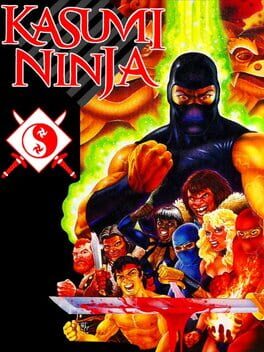
Kasumi Ninja
Kasumi Ninja — frequently asked questions
- Is Kasumi Ninja on Steam?
- No. Kasumi Ninja is not distributed on Steam, so there is no Steam Charts or SteamDB player count for it. Its live popularity is tracked here via Twitch viewership instead.
- What platforms is Kasumi Ninja on?
- Kasumi Ninja is available on Atari Jaguar.
- When did Kasumi Ninja release?
- Kasumi Ninja was first released on December 21, 1994.
About Kasumi Ninja
All hell is about to break loose! Stop the Evil Ninja Lord Gyaku from opening the Dragon Cloud temple's portal to Hell and unleashing his demon minions upon Kasumi Island and the world. Battle it out in this bloody brawler in 1 Player Story mode or Two Player versus mode as one of the 8 all-time greatest warrior-fighters. Gain fighting skill and master special moves from bout to bout as you journey through the Underground Labyrinth to the Dragon Cloud temple where you'll face your ultimate opponent: The Evil Ninja Lord Gyaku himself!
Summary via IGDB.
Kasumi Ninja on Wikipedia
Kasumi Ninja is a fighting game developed by Hand Made Software and published by Atari Corporation for the Atari Jaguar. It was first released in North America and Europe on December 21, 1994, and was later released in Japan by Messe Sanoh in July 1995. It was the first fighting title to be released for the Jaguar, and unsuccessfully sought to capitalize on the trend of ultra violent fighting games started by Midway Games's Mortal Kombat in 1992.
Source: Wikipedia (text under CC BY-SA 4.0).
Game details
- Platforms
- Atari Jaguar
- Developer
- Hand Made Software
- Publisher
- Atari Corporation
Details via IGDB.
Reception
Collector value & authenticity
Atari Jaguar · PriceCharting sold data · Verified 2026-07-24
- Region
- NA+EU
- Released
- 1994
- Authenticity
- Low
The game people use to dunk on the Jaguar — genuinely bad, in more interesting ways than its reputation allows.
Atari wanted Mortal Kombat money; Hand Made Software delivered a stiff digitized-sprite fighter (working title: Ninja Puncher) into a market drowning in MK imitators. Then there's Angus — a Scottish fighter in a kilt who throws fireballs from underneath it, the single most-remembered thing in the Jaguar's library, cemented as a punchline by the 2009 AVGN episode. One correction to the common record: this was NOT the Jaguar's first fighting game — Dragon: The Bruce Lee Story shipped three weeks earlier, on November 28, 1994.
Two things get overlooked. It sold 24,081 copies by April 1995 — fifth on the entire platform, ahead of Raiden and Iron Soldier. And it was one of the first console games to ship with a parental lockout system, months after the ESRB formed in the wake of the Mortal Kombat hearings. It gets zero credit for either.
How it was made
Hand Made Software developed the Atari Jaguar version. Credited: designed by Hank Cappa, Joe Sousa; programmed by Mark Lyhan, Nob Nicholson, Pete Wiseman; art by Andy Johnson, Greg Irwing, Martin Kilmer; music by Stephen Lord.
What the press said at the time
| GameRankings (aggregate) | 10% | |
| Next Generation | #3, March 1995 | 1/5 |
| AllGame | 2/5 | |
| Atari Gaming Headquarters | 1995 | 2 / 10 |
| Atari Inside | #2, February 1995 | 82% |
| Computer and Video Games | #159, February 1995 | 51 / 100 |
| Consoles + | #40, February 1995 | 73% |
| Excalibur | #42, March 16, 1995 | 72% |
| Game Players | #68, February 1995 | 40% |
| GamePro | #67, February 1995 | 13 / 20 |
| Games World | #9, March 1995 | 24 / 100 |
| Jaguar | #2, February–March 1995 | 65% |
| Joypad | #39, February 1995 | 65% |
| MAN!AC | #17, March 1995 | 39% |
| Mega Fun | #29, February 1995 | 48% |
| ST-Computer | #108, April 1995 | 80% |
| ST Magazine | #92, March 1995 | 74 / 100 |
| Super Game Power | #5, August 1994 | 3.5 / 5.0 |
| Última Generación | #3, May 1995 | 25 / 100 |
| Ultimate Future Games | #3, February 1995 | 38% |
| Video Games | #40, March 1995 | 69% |
| VideoGames | #74, March 1995 | 4 / 10 |
The contemporary press could not agree on this one: comparable scores run from 10% to 82% across 22 publications. Scores are printed in their original scales.
Cartridge & preservation record
Cartridge ROM capacity 32 megabit (4 MB), measured from the preserved cartridge image.
Surviving pre-release builds
| 1994-05-24 | Beta v0.29 | 32 Mbit |
Catalogue part number J9012E
Cartridge data from the No-Intro preservation database (metadata only — names, sizes and checksums, no game data).
Worth knowing
- It was designed for twenty characters and shipped with eight. Former Hand Made Software producer Jim Gregory attributes the cut to interference from Atari, which removed characters and other finished elements and reduced the cartridge's memory allocation. The roster people mock is roughly a third of the one that was built.
- Some copies shipped with a headband. A branded cloth headband was included with some copies at retail. It is not listed in most 'complete in box' descriptions, is trivially easy to omit, and is the kind of pack-in that quietly separates a genuinely complete copy from a merely boxed one.
- A sequel was in development when Atari closed. Kasumi Ninja II was underway for the Jaguar CD and was cancelled when Atari shut down, with Hand Made Software losing money on the work. The platform's most-mocked fighting game came within a publisher's collapse of having a sequel.
- A 1995 buyer itemised the ad against the game. Evan Meagher of Indianapolis wrote to Electronic Gaming Monthly in October 1995 listing what the advertising had promised and the cartridge had not delivered: two stages that were advertised and absent, and items collected after each battle to help through a 3-D labyrinth — “I saw no items and no labyrinth (unless you call a circular room a labyrinth)” — before signing off that he had a false advertisement suit to file. It is the sharpest surviving account of how much was cut, and it comes from someone who paid for it.
- EGM saw placeholder graphics a year before release. Answering a reader in March 1994, EGM’s editor wrote that Kasumi Ninja was the Jaguar’s only fighting game so far and “it isn’t finished yet. The characters you see in the pictures are only placeholder graphics. The finished version will have digitized graphics similar to Mortal Kombat.” The visual overhaul the game is known for is confirmed here contemporaneously, nine months before it shipped.
Before you buy
Common and cheap in NA/EU, with notoriety keeping demand slightly above where quality would put it. The Japanese release (via the Messe Sanoh retail channel, July 1995) is a genuine rarity — if you find one, photograph the packaging; whether the Japanese releases had Japanese packaging at all is an open research question.
Sales figures from an internal Atari document (through April 1, 1995), surfaced by The Land of Obscusion — The Land of Obscusion
Authenticity & condition — Atari Jaguar
Specific to the format this title shipped in
Buying a Jaguar cartridge
Cartridges are the durable half of this library — the risk is provenance, not decay. The platform has an active post-commercial scene, so the question is usually which era a cartridge is from rather than whether it still works.
- Ask for a photo of the label edge and the cartridge back. Reproductions are usually printed on adhesive photo stock and sit proud of the label recess.
- Donor shells are the common trick: sanding marks on the back, or adhesive ghosting where an older label was lifted, are the strongest signals.
- Cartridges are region-free on this platform, so a cheaper PAL copy plays on a North American console — a price difference is not evidence of a fake.
Kasumi Ninja screenshots


Watch on YouTube
Listings on The Game Traders
No active listings for Kasumi Ninja yet.
Be the first to list →Buyers looking for this
No active want ads for Kasumi Ninja yet.
Post a want ad →Popular games right now





Latest news mentioning Kasumi Ninja
No recent news mentions in our 30-day feed window.